Sunday, January 27, 2019

Storyboard


1st shot: This first shot is the establishing shot of the film. Already kicking off the film with a creepy and mysterious vibe, a detective's office is shown. As depicted from the clock, it is just after 5 AM. The shot pans over to the second shot, playing frantic jazz to build suspense.


2nd shot: Next is a close-up of the main protagonist. The camera stops on her, where she says her first line. The monologue continues, but as a voice over as the shot quickly changes to the 3rd shot through the use of a jump cut.


3rd shot: As the voice over comes to a close, the music returns. This time, a smoother jazz, suggesting that the build up is over and the movie is reaching a much calmer point. The shot begins with a close up on the back of this car, focusing mainly on the license plate. As the car drives further away, the camera pans upwards and the angle becomes wider. The voice over returns, introducing the story.


4th shot: As the monologue continues, the camera follows the car as it drives through the city. The music is still going, but at a lower volume to place an emphasis on the monologue. Low-key lighting is used, and this is where the title of the film is shown. The shot then jump-cuts to the fifth shot.


5th shot: The driver of the vehicle is shown, and it is the protagonist from the first two scenes. This scene is a bit introspective, as the dialogue gets more direct. The lighting is dark, but bright enough to clearly see the protagonist as well as the fact that she is in a car.


6th shot: the camera jumps from the last shot showing the protagonist in her rear-view mirror to her side mirror, also providing the viewer with a shot of introspection and intensity. The dialogue is building up, and as this is the final shot, leaves with a "bang." The music also picks up to match the intensity of the scene. The coloring remains the same. 


Sunday, January 20, 2019

Brainstorming for our Film


Personally, I really liked the opening to the first link “Rise,” where the camera focuses on the car mirror, then the soccer ball, and his soccer cleats, and kind of follows the character. In a way, this opening creates suspense for what is to come. My team and I will be creating a film noir, a film genre that highly consists of mystery and suspense. I did not particularly like the film opening for “Always Watching,” where the film focuses on two main characters talking to one another as an opening scene. To me, this is more of a shot for the middle of the movie.

Watching the different openings allowed my teammates to see what we do like versus what we don't like. My group and I certainly gained some perspective on possible shots to film for our opening scene.

Sunday, January 13, 2019

What Inspired Me to Create a Film Noir


As defined by Merriam-Webster, a film noir is a "a type of crime film featuring cynical malevolent characters in a sleazy setting and an ominous atmosphere that is conveyed by shadowy photography and foreboding background music." The word quite literally translates to black film in French. Film noir was first created in France in the 1930s. The first known film noirs include The Maltese Falcon and Laura. These films are dark, mysterious, and often give off the vibe as if they were created in the 20's.

My love for film noir films stemmed from 2010 television series Pretty Little Liars. The series follows four teenage girls following the disappearance and murder of their fifth best friend, Alison DiLaurentis. The entire series has a murderous and eerie tone to it, with their stalker “A” and other unwanted characters lurking in the shadows. However, in their fourth season, the series did something that they had never done before by introducing an episode done entirely in black and white.

Titled “Shadow Play,” this episode perfectly foreshadows upcoming events in the series whilst also taking viewers out of the perfect town of Rosewood and back to the 20’s for one hour long episode. The four friends are taken into this alternate universe as a result of Spencer’s overabundance of sleeping pills, therefore everything that follows in the episode is amplified by this feature. Ezra, Aria’s English teacher and long-term boyfriend is depicted as the villain, with his sidekick Mona (otherwise known as the original “A”). An otherwise grappling detail to note is that Alison herself comes back from the grave to make a feature in this episode, a foreshadow to the next season, where it is revealed that she was never really dead. In a way, this only multiplies the mystery and eeriness of the episode, as it left viewers thinking, “What does this mean?”

At only fourteen years old, I fell in love with the style of film noir from the instant that I saw the preview for this Pretty Little Liars episode on ABC Family. The beauty of the lack of color with the presence of shadows and mystery intrigued me. As shown in screen caps from Shadow Play below, the fashion and design known in this time period only added to this. Throughout the episode, the four main characters plus other female characters like Mona and Alison wear elegant outfits, hats, overdone makeup, pearls. It is very Great Gatsby in that sense.


Image result for pretty little liars black and white episode


  Related image  Related image  Related image


Related image


With my own film, I only hope to create the same ambiance through color, shadows, acting, design and makeup, and setting. There is such a specific feeling given through film noir films, a feeling of horror and romance that cannot be replicated. I know that with proper work ethic, time, effort, and creativity, my group members and I can create the same beauty that most film noirs encapsulate.

Thursday, January 3, 2019

Tuesday, December 18, 2018

Film Opening Research #2: La La Land


Image result for la la land


how many titles are displayed during the opening sequences to the film?

The titles aren't presented until four minutes into the film, when the Hollywood style "La La Land" appears and the camera pans in on the main character.

what images are prioritized in the opening sequence?

Cars, vibrant colors, bright and colorful clothing.

what connotations do the images carry?

The color scheme further reinforces the idea that this film takes place in the old Hollywood era

how is genre reinforced through symbolic and technical codes from the outset?

The film is a romance, comedy, drama, musical, and chick flick (which essentially encapsulates all of the above), which is present through the upbeat music, bright colors, and dancing.

how does the film establish an enigma from the outset?

From the trope of old Hollywood film and musicals, La La Land effectively follows this by providing the classic fonts and editing, the upbeat music, and colorful scenes.

what strategies are used to ensure the film appeals to its target audience?

Arguably, their target audience would be young or teenage girls, and strategies such as loud and upbeat music

how has technology been used effectively? 

The use of editing has been used effectively by creating a ethereal aura for viewers


Friday, December 14, 2018

Film Opening Research #1: Clueless


Image result for clueless

how many titles are displayed during the opening sequences to the film?

Paramount's infamous title is displayed to formally open the film. From there, a less formal and more Clueless-style title appears naming Paramount as the production studio in charge of the upcoming film. The film title Clueless appears on the screen making this the second title appearing during the opening sequence.

what images are prioritized in the opening sequence?

A jeep, Cher's shopping bags, a cherry.

what connotations do the images carry?

Each of these gives off a great feeling of lavish-living. It is clear that Cher and her friends have no care in the world, as the scene continuously switches back and forth from the friends riding past palm trees in an open Jeep, sitting by the pool laughing, sitting in a restaurant eating as they feed one of their friends a cherry. Each of these symbols gives off an idea that Cher and her friends are living a carefree life.

how is genre reinforced through symbolic and technical codes from the outset?

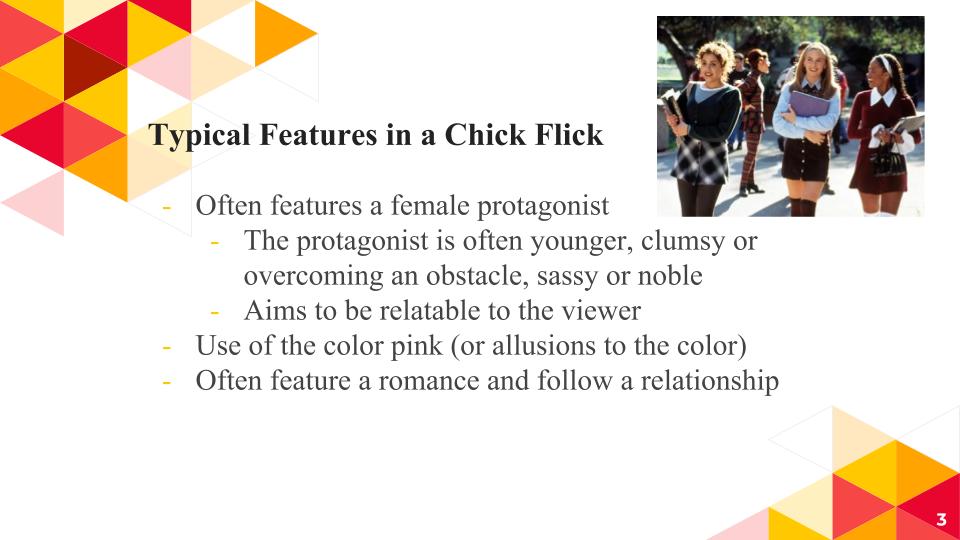
Clueless is a chick-film, and the lavish, carefree, excited nature of the opening scene supports this.

how does the film establish an enigma from the outset?

The film begins with a dozen of rich teenagers living their best life- what else is going to happen? Based off of the trope that Hollywood has created surrounding rich young adults and their ridiculously unrelatable lifestyles and problems, it draws viewers in and makes them wonder what could go wrong in this character's picture perfect life.

what strategies are used to ensure the film appeals to its target audience?

Being that this film is a chick-flick, there is the typical pink, feminine decor and graphics.

how has technology been used effectively? 

Clueless was produced in 1995, right as new technology began to develop in the film industry. The director uses slowed-down, shaky filming to give a more authentic shot of the teenagers. Also present, albeit unrealistic, is Cher's computerized closet. Through this use of technology, Cher picks through photos of the items in her closet and chooses her outfit electronically. This use of technology was extremely unknown and unrealistic to people during this time, as technology had not yet grown to what we see now, two decades later.

Friday, November 2, 2018

Film Viewing Practice Essay


There are visible and audible aspects of camera shots, angles, movement and composition, editing, sound, and mise-en-scène within the film Agent Carter. Each of these components plays a key role in the development of the plot throughout the film.
As a whole, the use of camera shots, angles, movement and composition is prevalent throughout the film. An establishing shot is in place to establish the setting during the shot which shows a wide view of New York City. The city, as we know it, is extremely lively and constantly on the go. Yet, this scene places it as slowed down for just a second, which allows viewers to mentally picture this setting as the “home base” for the movie. A choking shot is used quite literally in the scene where Peggy is being choked by a man in a gas mask. The camera constantly switches back and forth in movement, showing the man choking Peggy and Peggy’s response while fighting back to create suspense and tension for the viewer. The use of angles clearly establishes this movie as very pro-girl power, in a way. When Peggy is talking to the two men, an over the shoulder shot is used which makes the viewer feel as though they are a part of the conversation, themselves. Nonetheless, the use of this shot also shows Peggy’s status amongst these two men. Regardless of their burly demeanor and fancy trench coats, she is every amount just as powerful and strong, even with the uneven numbers.
To advance the plot, Pudovkin’s edits can be found throughout the film. At the very beginning of the film, the camera constantly switches back and forth between Peggy, sitting in her office, and Steve, who is at the moment in a position of danger while flying his aircraft. This use of parallelism establishes a clear comparison as well as contrast between the two protagonists and their situations. Both are clearly on edge and in positions of high stress, but there are clear differences behind their reasons of stress. In Steve’s case, he is in a life-threatening situation, whereas Peggy’s case is much less extreme.
In regards to sound, a sound bridge is used to “bridge” two scenes together. Within Agent Carter, a sound bridge can be found to tie the scene of the aircraft to the establishing shot of New York City. The use of this sound technique easily moves the viewer from a scene of high intensity to a much calmer, less intense scene. In a way, the use of the same music throughout these two scenes creates a clear contrast of energy between the two scenes.
Last but certainly not least, the use of mise-en-scène is extremely prevalent throughout the film. Throughout Agent Carter, instances of sexism and a clear lack of equality between Peggy and her male counterparts is evident. Peggy is dressed very feminine, with curled hair, makeup, and a lower cut shirt. This directly contrasts societal standards in regards to her powerful and dominant personality. In society, it is uncommon for women to dress effeminately, yet act in such a dominant way. Staging is also used as a technique to show Peggy’s stance amongst the male protagonists within the film. In one scene, Peggy is standing across from a group of men during a discussion, displacing her from the rest of the group and insinuating a sense of inequality between the two.
In total, the use of camera shots, angles, movement and composition, editing, sound, and mise-en-scène throughout Agent Carter plays a vital role in the progression of the film, as well as the audience’s reaction to specific situations.

Tuesday, October 30, 2018

Film Elements Graphic Organizer


CAMERA SHOTS, ANGLES, MOVEMENT, AND COMPOSITION

1. Establishing shot: sets the location for a scene
2. Low angle shot: provides the viewer with a perspective from below
3. High angle shot: provides the viewer with a higher perspective, from above
4. Dolly shot: following the subject, making the camera appear as though it is on a train track
5. Birds eye viewer: shot from high high above, allows the viewer with an over-arching perspective


EDITING

1. Contrast: cuts back and forth between two scenes to suggest a contrast between the two of them. A dichotomy would occur where the first scene shows one extreme, and the second shows an opposite extreme
2. Parallelism: connects two scenes by focusing on one aspect that is paralleled between the two, even if the scenes appear unconnected at the surface
3. Simultaneity: builds suspense by showing two action-filled scenes occurring at the exact same time
4. Leit motif: repeating a shot and a specific sound or song, to show the recurrence of that scene or concept
5. Symbolism: tying together two scenes through the use of a symbolic object or concept


MISE-EN-SCENE

1. Staging: The particular way that actors, furniture, or other objects are placed in a scene. This is completely thought out by the director and producer, to "stage" the scene in the most effective way possible to suggest a certain mood. 
2. Acting: The actor's performance in the movie or play; this is extremely important to the overall flow of the movie as this can truly make or break the quality of the performance
3. Costume: The actor's appearance in the scene, which can provide context of the character's archetype, the time period, the weather, the character's age, etc. Costume can include makeup and wardrobe. 
4. Setting: Provides a mood, place of mind, or establishing location for the scene. This can be as simple as a dark room with a flash of lightning through the window, which would set the mood as eery; this could also be as extreme as an entire football stadium, filled with the cheers of the crowd and the whistle of the ref. This would allow for an exhilarating mood throughout within the scene.
5. Three-point lighting: key, fill, and back light is arranged in such a way that the scene is illuminated

SOUND

1. Direct sound: recorded while filming, and is not edited in afterwards
2. Diegetic sound: both the audience and the characters can hear
3. Non-diegetic sound: the audience can hear the sound, but the characters on screen cannot
4. Sound bridge: bridges one scene to the next
5. Off screen sound: sound is off-screen, whilst the camera remains focused on the action occurring onscreen 


Creative Critical Reflection

click  here  to view my creative critical reflection for our film Carmen!